Random Variables & Probability distributions
Discrete variables
Probability function
For a discrete variable X that can take values from
There are two major types of distributions for discrete variables (based on
- Binominal distribution
example: observe
times of heads when flipping coins for N times. Then X=1, 2, ..., N follows this distribution.
- Mean
- Variance
The Bernoulli distribution is a special case of the binomial distribution with
- Mean
- Var(X) = p(1-p)
Poisson distribution
It always works when X represents the number of events that happen within a temporal or spatial domain.
Binominal → Poisson
Poisson is an extreme case of binominal distribution:
for
Continuous variables
Probability density function (PDF)
For continuous variables, probability density functions are more useful than cumulative distribution functions.
For a continuous variable X with its CDF F(x), there is a probability density function of x:
The probability density function has 3 features:
- The PDF's analog for discrete variables is probability mass function (PMF). But, they are not same!!!
- PDF is not Probability! It only means how much probability is concentrated per unit length (d𝒙) near 𝒙, or how dense the probability is near 𝒙.
- For discrete random variables, we look up the value of a PMF at a single point to find its probability P(𝐗=𝒙).
- For continuous random variables, we take an integral of a PDF over a certain interval to find its probability that X will fall in that interval.
- Thus, PDF can be greater than 1, such as in an exponential distribution:
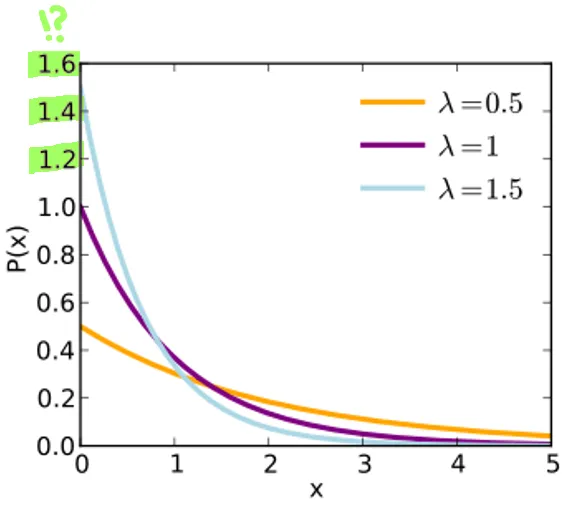
There are several major types of distributions for continuous variables (based on PDF):
Normal distribution
Exponential distribution
- expectation
- variance
Weibull distribution
The exponential distribution is a special case of the Weibull distribution with \alpha = 1.
PDF:
CDF: